
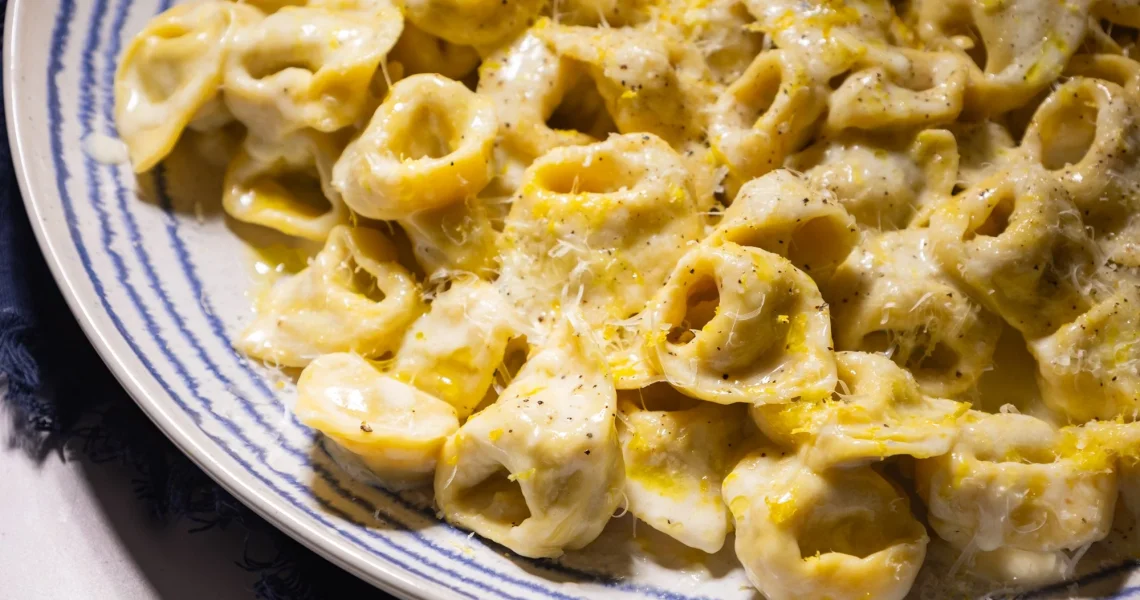
Tortellini, whether from Bologna or Valeggio sul Mincio, are a classic Italian dish. Nowadays, 500g packages of tortellini can be found on the shelves of the finest supermarkets around the world.
In the 1980s, this wasn’t the case, at least in Denmark.
At the time, I was collaborating with Katia, a designer with a Danish father and an Italian mother. One day, during a break, she told me about her desire to export Italian culinary products to Denmark. Her family was well-connected with high society in Copenhagen, and Katia believed it would be an excellent way to enter that market.
I asked her what products she was thinking of exporting, at least initially. She replied that she’d thought of tortellini because she’d never found them in Danish supermarkets or on the menus of any Copenhagen restaurant. She loved them and thought the Danes would love them too, whether they were prepared in broth or dry.
Katia didn’t know that I had an uncle who was the General Manager of a well-known company producing fresh foods, including tortellini.
After the business meeting, I called my uncle and arranged a meeting with Katia. My uncle was very helpful and guaranteed a free supply of packaged tortellini to ship to Copenhagen.
It was September and Katia began making various contacts to organize a culinary presentation.
At the time, SMS and other computer services did not exist, which meant that communications were exclusively by telephone, which were usually short due to costs.
Katia was going to Copenhagen to spend the Christmas holidays with her family, so she arranged everything so that the culinary presentation would coincide with her trip.
Katia availed herself of the help of a friend, the wife of a high-level manager of a well-known Danish company.
The event was organized. About twenty ladies of Copenhagen’s high society were to be present.
None of them, including Katia’s friend, had ever been to Italy and didn’t know the language at all; so their curiosity and anticipation were great.
The tortellini packages were shipped. The presentation date was approaching, and everything was proceeding according to plan.
Katia couldn’t make it to Copenhagen for the presentation due to a flight crew strike, but she was relaxed. Danes are naturally excellent planners, and Katia was no exception.
She managed to get to Copenhagen the day after the presentation and immediately contacted her friend to get feedback on the event.
The friend explained to Katia that all the people who had confirmed were actually present and that everything had gone very well.
Katia obviously asked the obligatory question:
“Did you like the tortellini?”
The friend replied:
“Yes, but they found them a bit harsh.”
“How hard are they? How did you cook them? How long?”
The friend, with an astonished and incredulous expression, replied:
“But did they have to be cooked? Weren’t they already ready?”
The tortellini were served raw, with the addition of butter and sage!!!
Months later, the culinary presentation was redone in the correct manner, cooking tortellini, and it was obviously a huge success, paving the way for the export of tortellini.
That’s how my uncle, laughing, called them “the Vikings’ Tortellini”.